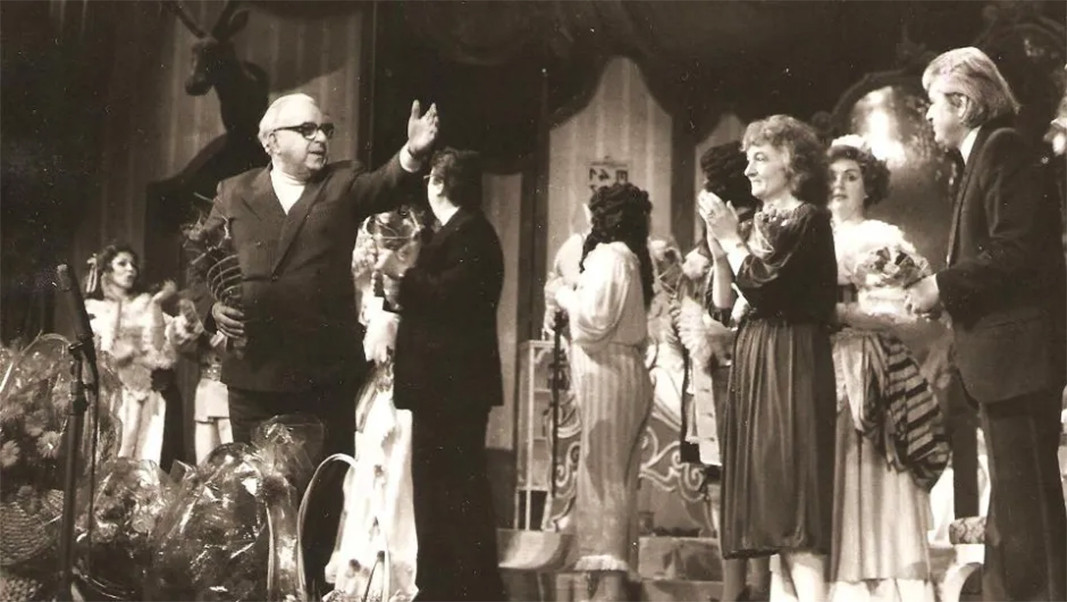
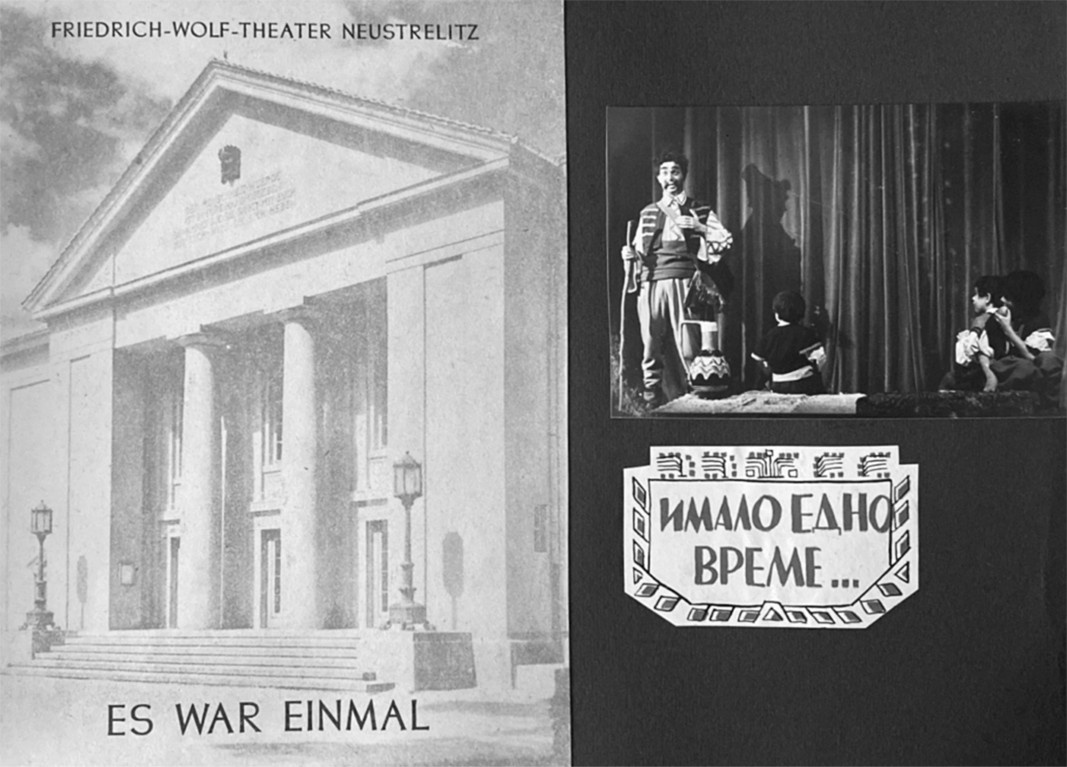
Three years later, his second operetta, the lyrical Aika, was staged at the Musical Theatre to great acclaim. Encouraged by this success, Hadjiev went on to create his first opera. It was appealing and accessible, and it quickly gained popularity. Over the next two decades, it was performed on every major Bulgarian stage, including those in Sofia, Plovdiv, Varna, Ruse, Stara Zagora, Sliven, Burgas, Pazardzhik and Veliko Tarnovo. On 30 October 1960, the opera premiered at the Friedrich Wolf Theatre (now the Landestheater Neustrelitz) in Neustrelitz, in a production created entirely by a German team.
Once Upon a Time tells the story of Kalina, a beautiful maiden who is courted by Radoyko, a man who lives 'beyond nine villages and into the tenth'. Although her father consents to the match, her mother is opposed and swears Kalina to silence for a full nine years, even from her husband. After the wedding, Radoyko, deeply in love with his wife, tries in vain to 'cure' her with the help of folk healers, sorceresses, and even a fantastical Gypsy ritual.
It is not until the fourth act that the legendary folkloric duo Hitar Petar and Nasreddin Hodja arrive in the village. They bet on who can solve the problem of the 'silent' Kalina. When the Hodja’s spells fail, Hitar Petar (literally 'Wily Peter'), the legendary Bulgarian trickster, declares that the only solution is for Radoyko to take another wife. He selects a local girl for Radoyko. Only then, terrified at the thought of losing her beloved, does Kalina break her mother's vow and speak.
One of the most beautiful arias in the opera is Kalina's aria at the end of the second act, following the failed attempts of various folk healers. The young woman pours out her grief: she needs no spells or folk remedies. 'Kalina wishes to speak' — yet she remains bound by her mother's oath. The aria is a true tour de force, showcasing a composer intimately familiar with the capabilities of the coloratura soprano (not surprisingly, Hadjiev’s mother was a leading coloratura at the Sofia Opera).
Its vivid melodies, infused with Bulgarian folk spirit, masterful construction, striking orchestration, and dazzling virtuosic passages have made Kalina’s aria a favourite concert piece for many Bulgarian sopranos. Perhaps the most acclaimed interpretation is that of Sofia Opera soloist Elena Stoyanova, accompanied by the Bulgarian National Radio Symphony Orchestra under conductor Ruslan Raychev — a recording from 1988.

The rock musicians from Horizont band and the singer Mariana Popova have recorded a joint song – ''Without You''. ''We’ve known Mariana since the time when she sang in a very solid band (Kokomania). Even back then she was our favorite because of..

Lili Ivanova will sing for the second time in the Olympia Hall. The concert is scheduled for May 24, 2026 and is under the auspices of President Rumen Radev, the team of the pop star informs. Lili Ivanova sends special thanks to..
One of the events with which Mary Boys Band mark their 30th anniversary is a concert with a large symphony orchestra in Bulgaria Hall in Sofia on November 21. The singer in the band, Maria Mutafchieva – Mary, says that this has been her dream for a..






 Mostly Cloudy
 Partly Cloudy
 Cloudy