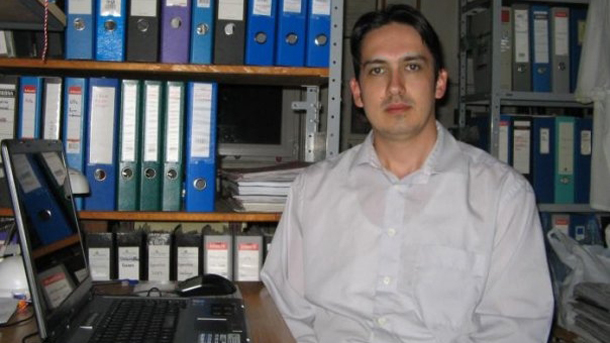
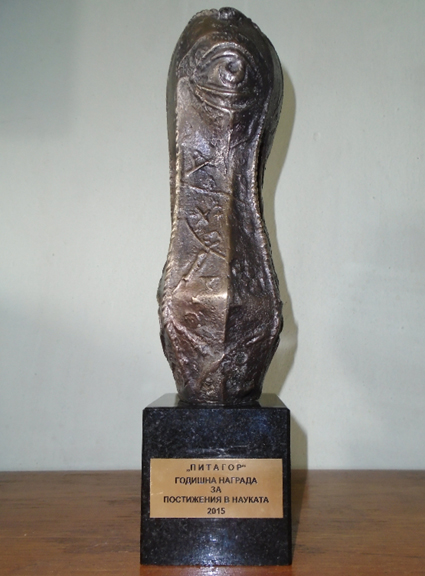
The adventure called science has no beginning or end. Perhaps that was how Pythagoras himself used to think, as he was presented by the legend as a half god-half human, a wonder-maker who devoted himself to all types of mysteries. A hundred odd young Bulgarian scientists continue to follow their natural child curiosity, which makes them search for the answers of very complicated questions. Today we will introduce you to Associate-Professor Dr Georgi Yordanov who is this year's winner of the Pythagoras Prize in the Young Scientist category. The award was handed in for the seventh consecutive year by the Bulgarian Ministry of Education and Science. Georgi is a lecturer at the Faculty of Chemistry and Pharmacy at the Sofia University Saint Kliment Ohridski. He has a very impressive career behind his back for his fragile age. He wrote a series of publications in international magazines. Georgi earned high distinctions from chemistry Olympiad competitions in India and Denmark.
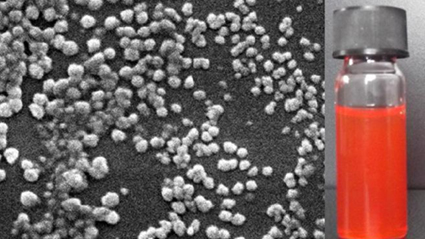 “My research activities are directed in the field of Biomedical Nanotechnologies. Generally speaking, we produce nanoparticles, in order to use them in medical treatment and diagnosis. The nanoparticles are extremely small particles, a hundred times smaller than a red blood cell. Their task is to transmit medical substances. Our research is directed mainly towards the transmission of anti-cancer medical substances to the cancer cells. When the nanoparticles enter the blood system, they can reach the cancer cells, because the blood vessels in the cancer formations have openings in their walls. The normal tissue does not have such apertures and the nanoparticles can not penetrate them. In fact, the scientific field called Nanomedicine is based on this fundamental idea. ”
In other words, Associate Professor Yordanov proves that thanks to nanoparticles the medical substances ca reach quickly the affected area of the human body without stratifying in other parts of the body. Thus, the side effect of the medicine is avoided, because each side effect is due to the accumulation of medical substances in healthy tissues and organs.
 The team of Associate Professor Yordanov works with material used for the manufacture of surgery glue. It is compatible with the human tissue and dissolves well inside the body. When this material enters the body, the nanoparticles do their job and then disintegrate. Bulgaria is among the few countries which produce such type of surgery glue. We also asked Associate Professor Yordanov whether receiving the Pythagoras statuette at Christ's age was a positive sign. Here is what Georgi Yordanov told Radio Bulgaria:
“Yes, this a good sign. Every person has expectations and dreams. I am dreaming to finish what we started in Bulgaria. It is a very difficult task, because the scientific projects in Bulgaria are interrupted somewhere in the middle. For instance, we had a project under the Scientific Research Fund which was very well evaluated, but it was abandoned due to the lack of finance. Our main task is to complete our job to the end, despite all difficulties. I wish those who chose to walk on the road of science good luck, to have enough courage and keep their curiosity, which is the basis of science. As all chemists like to say we continue to look for the philosopher's stone", Associate Professor Yordanov said.
English version: Kostadin Atanasov

The Bulgarian Embassy hosted the second concert of the 17th season of the Bulgarian Music Society in Washington. On 14 November, guests enjoyed a unique show by two world-class artists, both originally from Bulgaria: Desi Jordanoff, a folk dance master,..

Generation Z students (born 1995–2012) are widely using artificial intelligence in their learning, with teachers reporting that more than 85% complete homework and study with the help of digital assistants. Children tend to see AI as a partner..

This year, Christmas has "arrived" in Sofia as early as November with the aroma of mulled wine, cinnamon and festive magic. Radio Bulgaria recommends that you visit some Christmas spots in the Bulgarian capital city: For those most impatient to..







 Partly Cloudy
 Mostly Cloudy