
Bulgaria’s President Rumen Radev has issued a decree to promulgate a bill of amendments to the Electoral Code in State Gazette. On April 29, 2021, Bulgaria’s National Assembly adopted amendments to this country’s Electoral Code. The amendments to the Electoral Code will be promulgated in the extraordinary issue of State Gazette on May 1.
On April 29, Bulgaria's National Assembly adopted the following amendments to this country's Electoral Code:The number of polling stations abroad will be unlimited, the parliament has finally voted. After a re-vote that GERB called for, the votes "in favour" were 117, while 107 abstained and 8 were against the change. The amendment was adopted after a heated debate in plenary hall. The change was proposed by the party "There Is Such a People" (ITN) and it was supported by "Democratic Bulgaria", "Stand Up! Thugs Out” and MRF.
The National Assembly authorized establishment of polling stations abroad, based on at least 40 voting applications submitted, instead of 60 applications submitted.
So far, the polling stations have been limited to 35 for non-EU states, and the limit was introduced by GERB and the Patriotic Front in 2016 with the idea of limiting votes from Turkey. After Brexit, the restriction created a problem due to the large number of Bulgarian citizens in the UK, who complained that they had failed to vote.
However, there will be no electoral district “Abroad”, because the MPs did not approve the zoning methodology. People placed under quarantine will be able to submit voting applications on the day of elections.
The composition of the Central Election Commission (CEC) is reduced from 20 to 15 people. According to the new amendments, the members of the Central Election Commission will be appointed by Bulgaria’s President upon a proposal of the political parties and coalitions represented at the National Assembly. The political parties will nominate the Central Election Commission’s chairperson, deputy chairperson and secretary, but the entire commission will be appointed by a Presidential decree, following public consultations and a procedure determined by this country’s head of state. Parties and coalitions with MEPs will no longer have representatives at the Central Election Commission, if they are not represented in Bulgaria’s Parliament. Bulgaria’s Parliament approved 100% machine voting in polling stations with more than 300 voters.
There will be no postal voting abroad. The MPs also rejected the proposal for an experimental electronic voting during the forthcoming Presidential elections.
The MPs approved a video surveillance in election commissions when ballots are counted and tally sheets are filled in. The process will be broadcast online. Tense debates were held on the introduction of the majority voting electoral system. In the end, the MPs agreed that the proportional electoral system would be used until the first regular general elections.
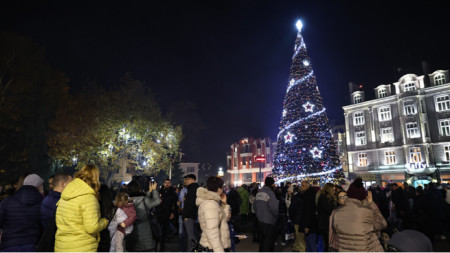
Plovdiv will offer concerts, bazaars and an ice park for the Christmas and New Year holidays to its citizens and guests, the municipality has announced. Mayor Kostadin Dimitrov will light the Christmas tree in front of the Plovdiv Municipality..

On Thursday, minimum temperatures will range from 3° to 19°C, with eastern areas reaching 15–19°C and Sofia around 6°C. The day will be cloudy with widespread rain. Heavy rainfall is expected in western regions overnight and in central and southern..

“Solutions for achieving peace in Ukraine must be based on fundamental principles of the UN Charter, such as sovereignty, independence and territorial integrity.” This was stated by Bulgarian Foreign Minister Georg Georgiev at the informal video..








 Mostly Cloudy
 Partly Cloudy
 Cloudy
 Fog
Fog