The third Sunday after Pascha is observed by the Orthodox Church as the Feast of the Holy Myrrh-bearing Women. Few people, mostly women, stood at the cross and witnessed Christ's crucifixion and death. On the third day, at dawn, the myrrh-bearing women went to the tomb to anoint Christ's body with incense, but instead of a lifeless body they found an empty tomb. As the women wondered what this meant, an angel appeared proclaiming that Christ had risen from the dead: “Why do you seek the living one among the dead. How could you have thought for a moment that He is the hostage of death? Do you not know that he is the principal of life? Rejoice!”.
In the Gospels, women play a central role as eyewitness at Jesus' death, entombment, and in the discovery of the empty tomb. The myrrh-bearing women had no idea of the coming Resurrection and the victory over death. They stood at the Cross only because of their love for Christ, beheld Him and co-suffered with Him.
The newest exhibition at the National Museum of Military History in Sofia, 'War and the Creatives: A Journey Through Darkness' opens today, offering free entry as a gesture to those who were unable to visit during the recent renovations. Rather than..
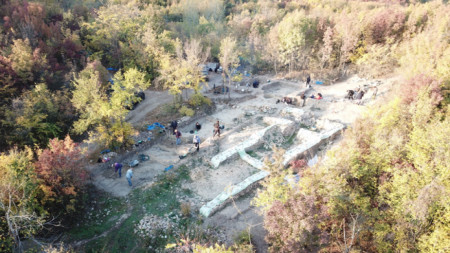
A 5,000-year-long history lies hidden in the ruins of the medieval fortress “Ryahovets” near the town of Gorna Oryahovitsa where active excavations began ten years ago. On this occasion, on November 17, the Historical Museum in Gorna Oryahovitsa..
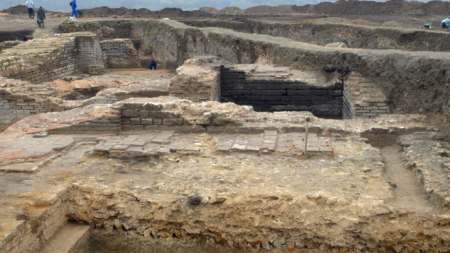
Just days ago, archaeologists uncovered part of the complex underground infrastructure that once served the Roman baths of Ratiaria - one of the most important ancient cities in Bulgaria’s northwest. Founded in the 1st century in the area of..






 Overcast, rain
 Mostly Cloudy
 Cloudy
 Rain / Snow
 Cloudy