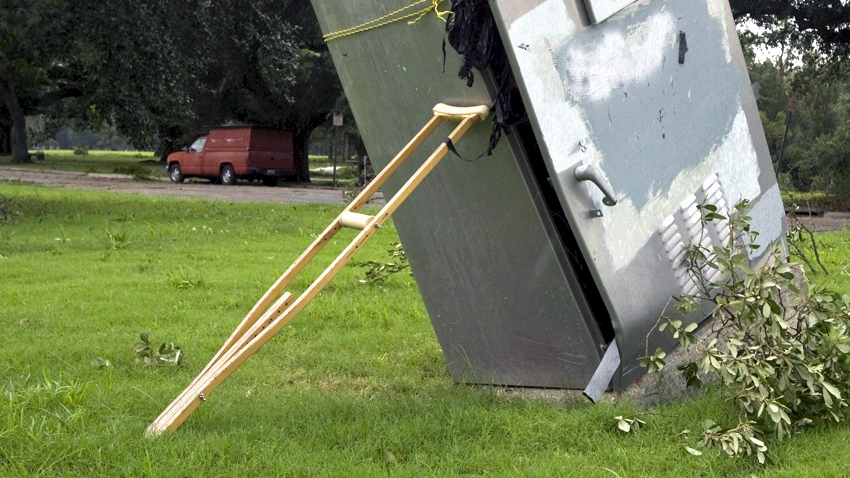
Statistics showed that in the past years of economic crisis the number of accidents and deaths on the job in Bulgaria has been declining. For 2013, however, the Social Ministry pointed out that the number of occupational fatalities was once again on the rise. The reason this time is not economic recovery but cuts in expenses, threatening life and health of the employees. More than 2000 accidents at work have taken place for less than a year and over 101 000 days were spent in hospitals because of accidents at work. It turns out that costs have not been cut, while losses for employers, workers and the state are huge. Meanwhile, labor inspectors have revealed nearly 200,000 cases of gross violations of safety rules at work. The most drastic violations are related to remuneration.
On the occasion of the World Day for Decent Work - October 7, trade union leaders pointed out that Bulgarian employers often doubled the working time of staff, but did not provide adequate remuneration. Companies even denied annual leave to workers, saying they lacked enough trained staff. A disturbing example is the plant of explosives in northwestern Bulgaria, where employees received the minimum wage. The recent powerful blast in the same plant took the lives of 15 workers and everyone started wondering who is to blame and how the tragedy could have been avoided. Expert work safety Valentin Iliev helped us in the search of errors leading to accidents.
"Bulgaria has good laws, completely synchronized with the EU ones,” he says. “Rules in Germany and France are the same like those in Bulgaria but there is the issue of the lack of will of the Bulgarian state to follow these rules. Accidents are the result of the overall situation in the country – corruption and neglecting working conditions. Priority for employers is the company’s profit which is often accumulated at the expense of workers' health. We are caught in a vicious circle where everyone cheats the next along the chain. Employers seek to show inspecting authorities that they obey the law. Their documents are fine, but in fact, no safety training was actually provided for workers. A major problem is that health and safety of workers is not a priority for managers at all levels. We have encountered drastic examples of ignorance when the basic principles that employers should keep up to are concerned. In other countries employers are aware that providing good working conditions is an important investment, which would return as profit. The EU legislation provides for occupational medicine but in Bulgaria these services are just imitation. The truth is that prevention is extremely important. But so far, attention is paid mainly to what brings incomes and quick profit. The explosives plant in Gorni Lom is an example of this. A worker there had to process nearly 100 mines per day. Fatigue accumulation makes one forget the rules of safe operation. It's all about management and workers cannot be blamed. Bulgarian workers achieve great results in countries such as Germany but in Bulgaria the situation makes them break the rules. The whole legislation aims at protecting life and health of people, and here workers do not realize that they are alone in protecting their health," expert Valentin Iliev says.
English: Alexander Markov
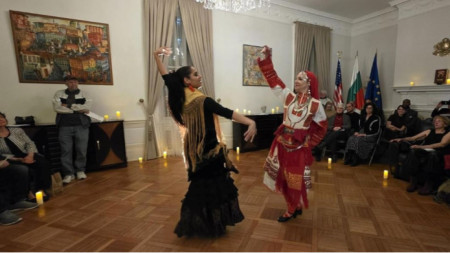
The Bulgarian Embassy hosted the second concert of the 17th season of the Bulgarian Music Society in Washington. On 14 November, guests enjoyed a unique show by two world-class artists, both originally from Bulgaria: Desi Jordanoff, a folk dance master,..

Generation Z students (born 1995–2012) are widely using artificial intelligence in their learning, with teachers reporting that more than 85% complete homework and study with the help of digital assistants. Children tend to see AI as a partner..

This year, Christmas has "arrived" in Sofia as early as November with the aroma of mulled wine, cinnamon and festive magic. Radio Bulgaria recommends that you visit some Christmas spots in the Bulgarian capital city: For those most impatient to..




 Mostly Cloudy
 Rain
Rain Scattered showers
 Cloudy
 Cloudy