
Statistics showed that in the past years of economic crisis the number of accidents and deaths on the job in Bulgaria has been declining. For 2013, however, the Social Ministry pointed out that the number of occupational fatalities was once again on the rise. The reason this time is not economic recovery but cuts in expenses, threatening life and health of the employees. More than 2000 accidents at work have taken place for less than a year and over 101 000 days were spent in hospitals because of accidents at work. It turns out that costs have not been cut, while losses for employers, workers and the state are huge. Meanwhile, labor inspectors have revealed nearly 200,000 cases of gross violations of safety rules at work. The most drastic violations are related to remuneration.
On the occasion of the World Day for Decent Work - October 7, trade union leaders pointed out that Bulgarian employers often doubled the working time of staff, but did not provide adequate remuneration. Companies even denied annual leave to workers, saying they lacked enough trained staff. A disturbing example is the plant of explosives in northwestern Bulgaria, where employees received the minimum wage. The recent powerful blast in the same plant took the lives of 15 workers and everyone started wondering who is to blame and how the tragedy could have been avoided. Expert work safety Valentin Iliev helped us in the search of errors leading to accidents.
"Bulgaria has good laws, completely synchronized with the EU ones,” he says. “Rules in Germany and France are the same like those in Bulgaria but there is the issue of the lack of will of the Bulgarian state to follow these rules. Accidents are the result of the overall situation in the country – corruption and neglecting working conditions. Priority for employers is the company’s profit which is often accumulated at the expense of workers' health. We are caught in a vicious circle where everyone cheats the next along the chain. Employers seek to show inspecting authorities that they obey the law. Their documents are fine, but in fact, no safety training was actually provided for workers. A major problem is that health and safety of workers is not a priority for managers at all levels. We have encountered drastic examples of ignorance when the basic principles that employers should keep up to are concerned. In other countries employers are aware that providing good working conditions is an important investment, which would return as profit. The EU legislation provides for occupational medicine but in Bulgaria these services are just imitation. The truth is that prevention is extremely important. But so far, attention is paid mainly to what brings incomes and quick profit. The explosives plant in Gorni Lom is an example of this. A worker there had to process nearly 100 mines per day. Fatigue accumulation makes one forget the rules of safe operation. It's all about management and workers cannot be blamed. Bulgarian workers achieve great results in countries such as Germany but in Bulgaria the situation makes them break the rules. The whole legislation aims at protecting life and health of people, and here workers do not realize that they are alone in protecting their health," expert Valentin Iliev says.
English: Alexander Markov

Three-time world champion and Olympic weightlifter Carlos Nasar will be holding a special event with the Bulgarian community in London on 23 November. According to the organisers, it will be an open conversation in which Nasar will discuss his journey..

On 16 November, we celebrate Caritas Day, when we honour the Catholic Church’s charity organisation that brings hope to those in need through care and acts of mercy . It reminds us that financial gain is not what matters most. What truly matters is..
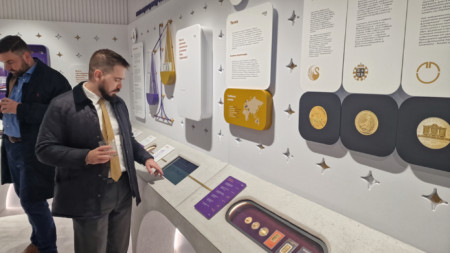
The first museum of investment gold is welcoming visitors in Plovdiv who want to learn more about the history of money and its connection to gold – from the birth of gold, its cosmic origin, and its journey to Earth, to how this precious metal has..





 Partly Cloudy
 Cloudy
 Cloudy
 Mostly Cloudy