Podcast in English
Text size
Bulgarian National Radio © 2025 All Rights Reserved

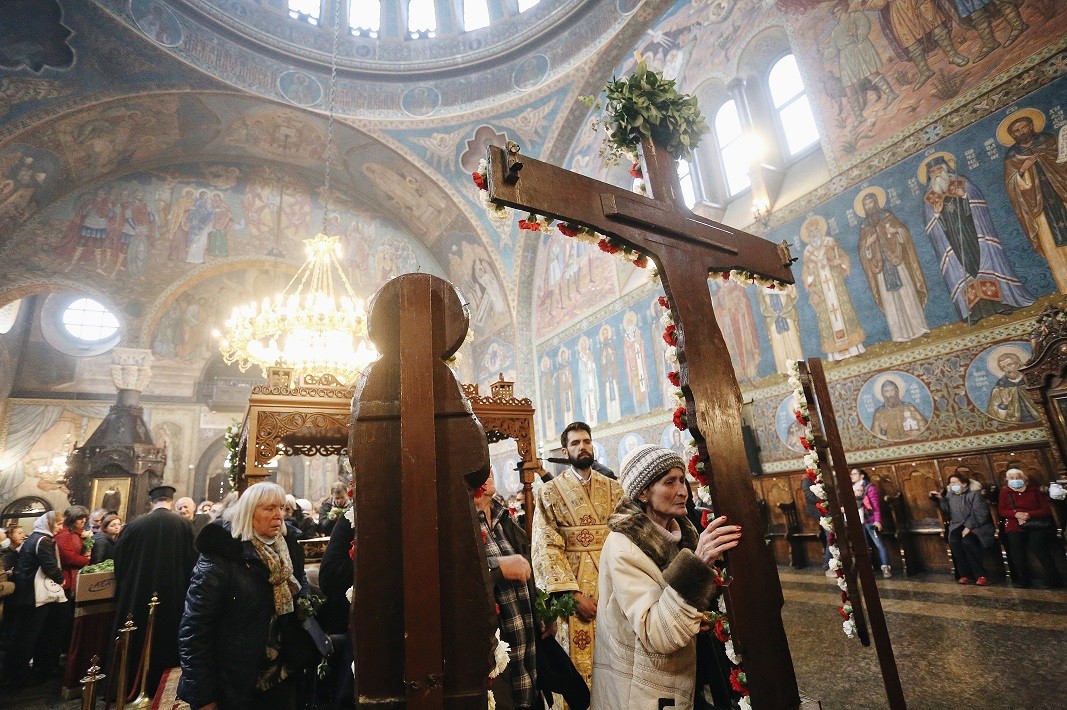
‎"Sepulchral lamentation" (Requiem Christ) – laudatory funerary chants on ‎Good Friday ‎

Photo: BGNES

During the holy liturgy in Orthodox churches of Bulgaria, there is one chant ‎that is performed only once a year. Only on Good Friday, the chant ‎‎“Nadgrobnoe ridanie" (Sepulchral lamentation in English), also known as the ‎‎"Opelo Christovo” (Requiem Christ) can be heard in churches here. It is part of a divine liturgy ‎connected with the Crucifixion and is a synthesized "narrative" of the Passions ‎of Christ (the sufferings of Jesus Christ) and the death of Jesus on the cross. ‎

The chant "Nadgrobnoe ridanie" is composed of three parts and has a specific and original melody ‎that has reached us unchanged from time immemorial. On the basis of this ‎anonymous work, one of the masters of the first generation of Bulgarian ‎composers, Dobri Hristov (1875-1941), created a unique polyphonic ‎composition that is still performed in churches today. In this way, the ‎sacrament of the Crucifixion and death on the cross is transmitted as a message ‎to the laity. This sacred moment is very moving and very sad and makes one rethink life. 

Within about 40 minutes, as is the duration of the chant ‎‎"Nadgrobnoe ridanie", the holy liturgy tells us about the pains and sufferings of ‎Christ to become the sacrificial lamb for all people and then to rise again. For ‎this, the songs do not sound so much like a lamentation but rather a praise of Christ's ‎deeds, of the victory over death and as an anticipation of the coming ‎Resurrection.‎


The version of "Nadgrobnoe ridanie" of the Svetoglas male ‎vocal group is shorter than the one performed in ‎church, but it recreates the main message of Good Friday. The music is by Dobri ‎Hristov - the composer who contributed the most to the development of ‎Eastern Orthodox music in Bulgaria. ‎

After studying composition in the class of Antonin Dvorak in Prague, Dobri ‎Hristov worked almost his entire life for the creation and development of ‎choral singing in Bulgaria, notes the prominent choral conductor Prof. Teodora ‎Pavlovich in a review of the Svetoglas album. ‎According to her, it is an exciting fact that the performance of "Nadgrobnoe ‎Ridanie” of the formation was carried out according to the author's ‎manuscripts preserved in the Patriarchal Church of St. Alexander Nevsky in ‎Sofia.‎


Translated and published by Rositsa Petkova


Последвайте ни и в Google News Showcase, за да научите най-важното от деня!
Listen to the daily news from Bulgaria presented in "Bulgaria Today" podcast, available in Spotify.

More from category

Parashkev Hadjiev (1912–1992)

Once Upon a Time: A fairy-tale opera by Bulgaria's master composer, Parashkev Hadjiev

Often described as “the Bulgarian Verdi” or “the Bulgarian Puccini,” composer Parashkev Hadjiev (1912–1992) has long been recognised as a central figure in Bulgaria’s operatic tradition. The country’s most prolific creator of musical-stage works, he left..

published on 11/28/25 4:45 PM

Veselin Marinov with four consecutive concerts in front of the audience in Sofia

Admirers of schlager music and expressive stage presence are certainly looking forward to the pre-Christmas meeting with Veselin Marinov. It has already been a long-standing tradition for the singer to have a concert in the National..

published on 11/25/25 9:51 AM
Scene from the film

"People and Streets” from the cult Bulgarian classic "The Boy Goes Away"

Photos: ubc-bg.com, архив, Facebook/ Filmotechno podcast Discover more Bulgarian music  in Radio Bulgaria's series "Highlights of Bulgarian musical culture": Highlights of Bulgarian musical culture: ''Barefoot times'' -..

published on 11/22/25 12:15 PM