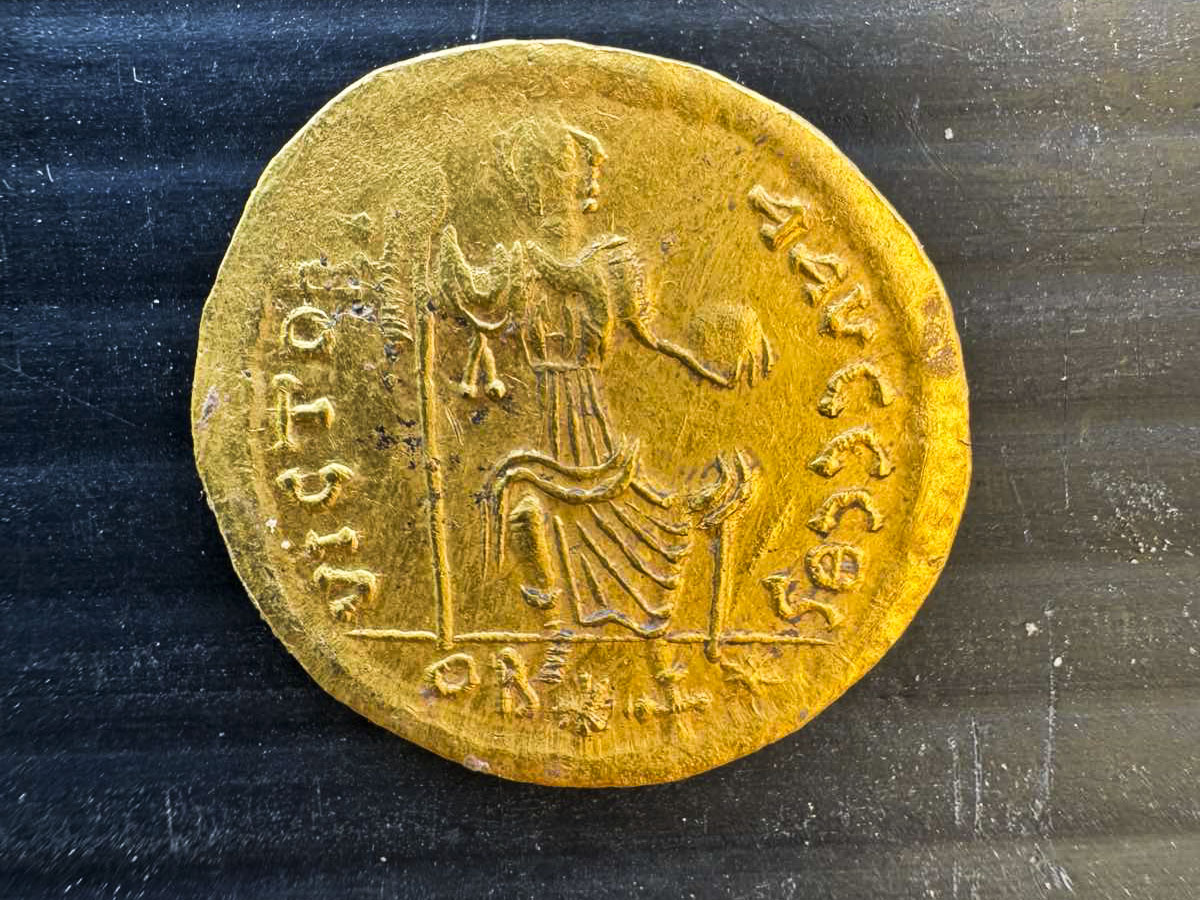
A gold coin minted during the reign of Emperor Justinian I, ruler of the Eastern Roman Empire, was discovered during excavations at the Tuida Fortress near Sliven. According to Associate Professor Dr. Nikolay Sirakov, Director of the Regional History Museum in Sliven, the discovery of a gold coin indicates that wealthy people lived in the fortress. Such coins were not used for trade but were symbols of prestige and investment, which is why they are rarely found.
This is the fourth such coin found in the fortress over the years. A total of 23 coins have been found this season, most of which are bronze and date from the 2nd–3rd century up to the 12th century. Belt fittings, a buckle, and even a book clasp have also been discovered, which, according to Associate Professor Sirakov, indicates that there was likely a scriptorium where books were written.
This year, excavations at Tuida are focused on a complex of residential buildings constructed with massive stone walls, dating from the 5th to the 12th century. The archaeological work is supported by the Ministry of Culture.
Edited by Darina GrigorovaPublished and translated by Kostadin Atanasov
Photo: BTA
In June 1878, after the 10 th Russo-Turkish war in a row, at the Berlin congress, the lands in the Balkans inhabited by Bulgarians were divided up into five. Northern Dobrudja was handed over to Romania. Serbia got the Sanjak of Niš. The lands..
The New Church Year begins on September 1. The month of September is the seventh month of the year according to the Jewish calendar. It is associated with a number of biblical events, which is why it was designated as the beginning of the Church New..
High in the canyon of the Rusenski Lom River lies one of the most impressive spiritual centers of Bulgaria. It is a complex of dozens of rock-hewn cells, chapels and churches carved on both sides of the river , which came to life in the 13th century..






 Mostly Cloudy
 Fog
Fog Partly Cloudy
 Cloudy